
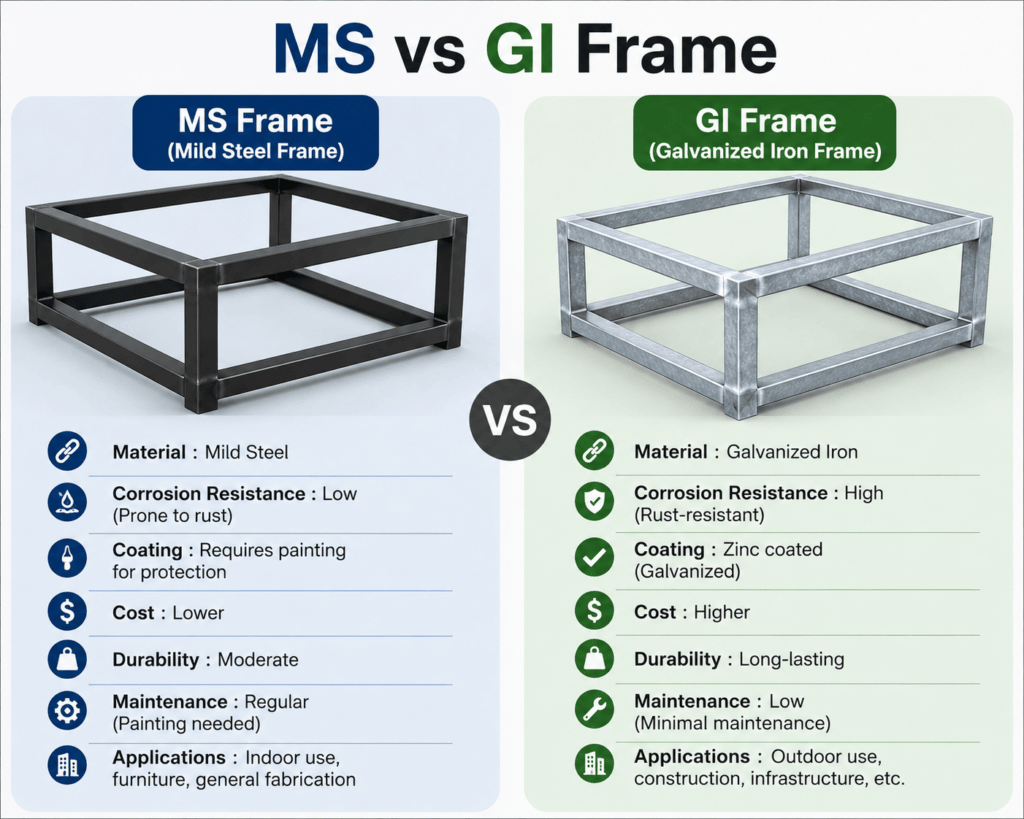
The skeleton is like the backbone of a building and will have an important influence on its strength and durability. A good quality frame is crucial for the long term performance of any portable office cabin, security cabin, warehouse, labour accommodation unit, industrial shed or modular building built on-site.
Today, we have many options of frames to choose from like MS, GI etc. Many fields use both with different advantages and disadvantages. Corrosion resistance, maintenance, durability, cost and environment are some essential factors to consider MS vs GI Frame Comparison.
In this article, we will offer a comprehensive comparison between MS and GI frames that will help businesses, contractors and project managers in making the right choice for their industrial and commercial needs.
Understanding MS Frames
MS is classified as low carbon steel which is easy to manufacture at low cost. Mild steels are being used in construction for decades because they have good mechanical strength and can be fabricated into various shapes and sizes.
MS frames are commonly utilized for industrial buildings, warehouses, machine shops, temporary offices and other types of commercial buildings. Mild steel is also easy to weld and can be customized for the production of a specific design. Hence, it is widely used to create custom designs.
You can use MS frames to carry heavy loads without losing their structure, that is why they became so popular. They are perfect for short-term and long-term use.
Understanding GI Frames
GI is actually Galvanized Iron but since that is the name of the material, it may be referred to by its common name as Galvanized Steel or Zinc coating on the steel. The galvanization process involves coating the steel with zinc to make it corrosion resistant.
Galvanized iron or zinc coated steel can thus be used in protecting steel from corrosion caused by moisture, oxygen, and many other factors in the environment.
GI frames are increasingly becoming popular and have been used in the construction of prefabricated cabins, site offices, portable toilets, security cabins, and even modular buildings. The galvanized iron makes them very resistant to rusting and is therefore best suited for outdoors as well as in humid places.
Another benefit that galvanized iron frames offer is that of longevity. They generally offer higher levels of rust protection than the corresponding steel buildings.
They are preferred by many businesses due to their dependability.
Corrosion Resistance: The Biggest Difference
Corrosion resistance is the first feature to be thought about when talking about MS vs GI frames.
MS frames are durable and strong, but the frames are subject to corrosion in case of contact with water, rain, or humid conditions. Even though it will be necessary to protect the frame by applying protective coating and thereby prevent rusting, after some time the coating will need to be re-applied due to wear.
On the contrary, GI frames are especially manufactured to withstand corrosion. Zinc layer serves as a barrier protecting the steel surface from corrosion since it prevents any possible contacts with the environment. The zinc coating maintains protective properties despite scratches.
Those companies which manufacture goods and products in locations such as coastal regions, rain-prone areas, or humid environments should definitely prefer the frames with increased corrosion resistance. Such a structure will last for many years without requiring much attention from the owners.
The ease of installation and replacement is one of the significant advantages of using GI frames in modern portable cabins.
Structural Strength and Load-Bearing Capacity
Strength of the MS frames is another important feature. Mild steel is very strong and can withstand heavy loads quite well, which makes it a preferred choice in industrial buildings.
Industrial buildings such as warehouses, industrial sheds, manufacturing plants, and storage sheds are constructed using MS frames.
The GI frames are also sturdy and strong enough to withstand heavy loads. Galvanization does not affect the strength of the steel. Rather, it provides a layer of protection that increases durability while retaining the strength of the structure.
MS and GI frames can be used to create excellent support in practical applications for industrial and commercial structures. So, in terms of strength alone, there is no one material that is better than the other.
It is often more about the environment and maintenance than about load bearing capacity.
Service Life and Durability
When deciding between MS vs GI Frame, it is important to keep in mind the anticipated life of the building.
If the MS frame is well maintained, it is capable of lasting for decades. Inspection and painting, as well as anti-corrosive measures, prevent any damage to the steel.
However, the failure to maintain an MS frame may lead to rusting of the frame, and thus reduce its lifespan.
GI frames tend to last longer because of their zinc coatings that provide constant protection from corrosion. This ensures that there will be no degradation to the structure at all.
In situations where long-term installations are planned, businesses may find that GI frames provide them with more security since they need less attention to keep them at peak performance.
This longer life span also helps to reduce the life cycle costs, making GI frames an appealing investment in commercial projects.
Maintenance Requirements
The cost of ownership is also a key factor in maintenance.
MS frames need to be maintained on regular basis so as to ensure that the protective coatings are effective. This could include repainting, rust treatment, inspections and repairs throughout the years.
If the building is situated in severe weather, the maintenance schedule may be even more frequent.
GI frames, however, are more low maintenance. The galvanized coating offers inherent protection and minimises the need for frequent checks and maintenance.
For businesses with multiple locations or large-scale facilities, this can be particularly crucial, as maintenance expenses can add up over time.
The reduced maintenance needs can save on costs and also reduce the impact on operations, making GI frames an attractive option for a wide range of industrial and commercial use.
Cost Considerations
Budget is often one of the most important factors in any construction project.
Initial cost of the MS frames is lower than the cost of the GI frames. The galvanized frames typically cost more at the start, because they have another manufacturing process.
If the project has a limited budget or is short-term, MS frames might be an economical choice.
But cost shouldn’t be the only one to be taken into account. Costs for long term items like maintenance, repairs, replacements should also be considered.
While the initial expense of acquiring the proper type of GI frames might be higher, they are often more economical over time due to their lower upkeep costs and longevity.
This is why a lot of companies consider both short and long-term costs before deciding upon a selection.
Applications in Mobile Homes
Portable cabins are proving to be invaluable resources for businesses in the 21st century because of their flexibility, mobility, and affordability. These are the typical uses of these structures:
1. Site office cabins
2. Security cabins
3. Portable toilet cabins
4. Labour accommodation units
5. Portable shops
6. Temporary healthcare facilities
7. Educational cabins
8. Modular office spaces
Portable cabins can also be built using MS frames, but it will probably take more to maintain them over their useful life.
Conclusion
If we compare the two materials, MS vs GI Frame, both materials provide high structural strength and can be applied in industrial and commercial applications successfully. But they have a lot of differences regarding their corrosion resistance, maintenance needs, life span and value.
Portable cabins, modular buildings, site offices and outdoor commercial buildings may well be built with GI frames, as they are durable and reliable. The initial investment could be a little more, but the benefits are usually worth the extra expense.
FAQs
1.What is the difference between MS frame and GI frame?
Corrosion resistance is the only differentiating factor between the use of MS frames and GI frames. The frames made out of MS (Mild Steel) are strong and economical, yet they require protective coating against rusting. In GI (Galvanized Iron) frames, the application of zinc gives them increased resistance towards rust, thereby providing durability to the structure.
2. Should we opt for MS frames or GI frames for portable cabins?
Mostly, it is observed that GI frames are more preferable for portable cabins because they are extremely rust resistant, moisture proof and weather proof, and thus have a higher lifespan.
3. Is it possible to erect outdoor structures using MS frames?
Yes, we can erect outdoor structures by using MS frames, yet we must ensure that proper painting and coating is done. However, such frames will be durable only if proper maintenance is ensured on a regular basis.
4. Are GI frames suitable for an industrial building?
Certainly, GI frames can be easily used in industrial buildings, warehouses, portable cabins and even commercial buildings.
Read More Blog:
Pre Engineered Building Manufacturers in Delhi NCR – Benefits, Features & Applications
Portable Office Cabin in Delhi NCR – Benefits, Uses & Complete Buying Guide 2026
Cement Panel Board Prefab Houses in Hyderabad: Cost, Benefits & Design Options