
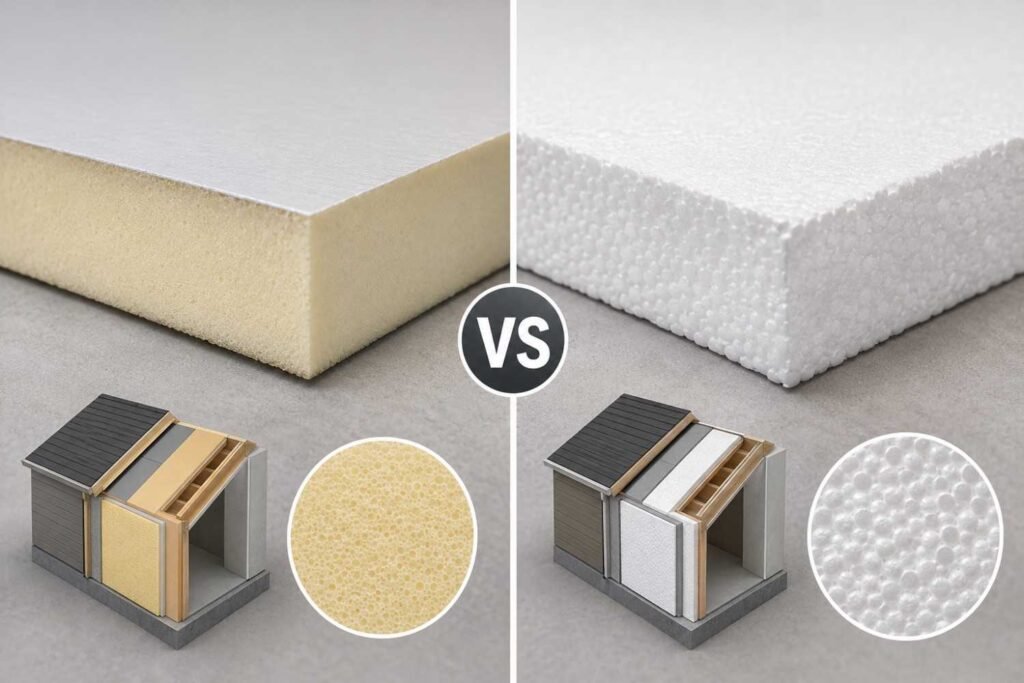
Do you know the fact that for choosing the right portable cabin, you must know the difference between the insulations? The best insulation panels that are available on the market are mainly PUF (Polyurethane Foam) and EPS (Expanded Polystyrene), and while considering PUF vs EPS insulation, you must clearly know the differences, pros and cons of both. Therefore, they must be chosen depending on the purpose and budget of the cabin.
Portable Cabins are widely used as security rooms, portable site offices, accommodation units, and grocery stores. The cabin should be cool in hot weather and warm in cold weather. Better insulation for the cabins matters in these cases. So, selecting the right insulation material enhances the cabin’s stability in harsh weather. The portable cabins need better comfort without heavy power consumption.
Read on to understand more about PUF vs EPS insulation comparison to determine which is better for portable cabins. You will also learn to decide between PUF and EPS insulation for your future project.
Table of Contents
ToggleWhat is meant by PUF when it comes to Cabins?
PUF (Polyurethane Foam) is basically a dense, rigid foam mainly used for reducing thermal conductivity, for maintaining indoor temperatures in a stable manner. It also offers moisture resistance. PUF panels are good for industrial portable buildings and cold storage. They will provide better insulation in a thin structure.
What is meant by EPS?
EPS (Expanded Polystyrene) is basically an economical, lightweight foam commonly used in prefab panels. It provides good insulation at a lower cost and is budget-friendly for temporary structures for the user. EPS is recommended if low cost is the priority. It works better for basic portable cabins and temporary installations. EPS provides lower insulation compared to PUF.
PUF vs EPS Insulation Comparison
A simple PUF vs EPS insulation comparison is given below.
PUF insulation
- Provides comparatively better insulation and thermal performance.
- The initial cost will be higher in most cases.
- Lightweight material
- Better for practical use in moisture resistance
- Good in fire-retardant grades.
- Best use in hot climates and for long-term use
EPS insulation
- Thermal performance is good, but slightly lower than PUF.
- Cost is lower.
- Lightweight material.
- Particularly less robust in demanding conditions
- Fire performance is lower than that of PUF insulation.
- Best use in low-cost projects and temporary structures.
Which one is a better option for Portable cabins
While selecting better insulation for the portable cabins, PUF insulation is a good option. Because in terms of thermal performance and durability. EPS insulation is budget-friendly but typically has less performance in robust conditions.
PUF is better when the cabins are long, exposed to sunlight, and other weather conditions. In summer, the PUF insulated cabin reduces AC load and helps to stay cooler. EPS can’t be neglected and is a sensible option when the cabin is for temporary use. EPS insulation is more than enough when the budget is low, and you are setting up a basic site cabin.
PUF is a stronger choice if the cabin is for regular use and placed in robust conditions. The insulation in PUF makes the long-term value of the material more practical.
Comfort and cost
In the case of cost, EPS wins on initial price. EPS is popular in low-cost portable cabins. But the cheaper material will cause a higher cooling or heating effect. PUF is the winner in terms of better comfort and long-lasting material. It reduces heat transfer. This is important because the small size of the cabin’s temperature changes is noticed considerably.
Durability and Maintenance
PUFs are generally more durable than EPS. Portable cabins face heat and moisture in daily use. PUF’s rigid material holds up the cabin in demanding weather conditions. While EPS is less robust and is vulnerable to erosion in harsh weather.
If installed properly, both PUF and EPS need very little care daily. The maintenance required is for protecting the panels from water leakage and physical damage. PUF requires less attention over the long term than the EPS because its insulation performance is better. While EPS is vulnerable to moisture and heat.
Thermal Performance Comparison
PUF insulation is a better thermal performer than EPS. PUF reduces heat transfer more effectively. The thermal conductivity of PUF is lower, which keeps the indoor temperature more stable and prevents heat.
PUF insulation requires less effort from the AC or heating systems. It has the ability to stay cooler in summer and warmer in winter, which is an important factor. This feature also makes PUF a better alternative in harsh climates. EPS is also a better performer in moderate conditions and when the budget matters. It generally needs more energy from the heat-regulating systems to give comfort, as it is less efficient at reducing the heat flow.
Overall, PUF is a good option if thermal performance is your priority. EPS is a reliable option for temporary or basic use.
Practical Recommendation in a Real World Scenario
PUF insulation is considered a better practical option and recommended when it comes to energy savings and comfort. EPS insulation is also a useful choice for budget projects, and thermal demand is moderate. We recommend PUF if the cabin is exposed to strong sunlight or a cold climate. PUF is preferred in demanding conditions. It provides better insulation and better temperature control. If you are up for a lower upfront cost, choose EPS. EPS insulation is good if the cabin is lightly used. It is still a better option for a decent insulation performance and is easy to install.
Conclusion
The PUF vs EPS insulation comparison discussed in this blog will definitely help you to make a better choice and a practical solution, although they both have advantages and disadvantages. In many real-world scenarios, EPS is recommended for a smaller budget or temporary use, while PUF delivers superior insulation performance and doesn’t need much maintenance. PUF insulation is a smarter choice for a long-term solution. It holds the cabin together in energy efficiency and comfort in robust weather conditions. If you prefer performance and durability the most, then opt for PUF, and if you want to reduce cost, EPS is the best solution available.
FAQs
1.What does PUF insulation really mean in practical situations for cabins?
PUF stands for Polyurethane Foam, and it is basically a rigid foam used as an insulation material for cabins. It is mainly used and is applicable in sandwich panels for portable cabin structures.
2.What does EPS insulation mean in real world situations?
EPS stands for Expanded Polystyrene, which is a cost-effective insulation material used mainly in budget-friendly portable cabins.
3.Which is more expensive among the cabins, among PUF vs EPS insulation?
PUF is expensive compared to EPS. Because PUF generally provides better comfort and durability.
4.Which insulation is good and better for hot climates?
PUF is better in high temperatures, as it prevents heat more effectively and keeps the cabin cool.
5.Which one requires less maintenance, PUF or EPS?
PUF performs better in demanding conditions and thus requires less maintenance. While EPS needs more maintenance and is not recommended in harsh environments.
Read More Blog:
Pre Engineered Building Manufacturers in Delhi NCR – Benefits, Features & Applications
Portable Office Cabin in Delhi NCR – Benefits, Uses & Complete Buying Guide 2026
Cement Panel Board Prefab Houses in Hyderabad: Cost, Benefits & Design Options