
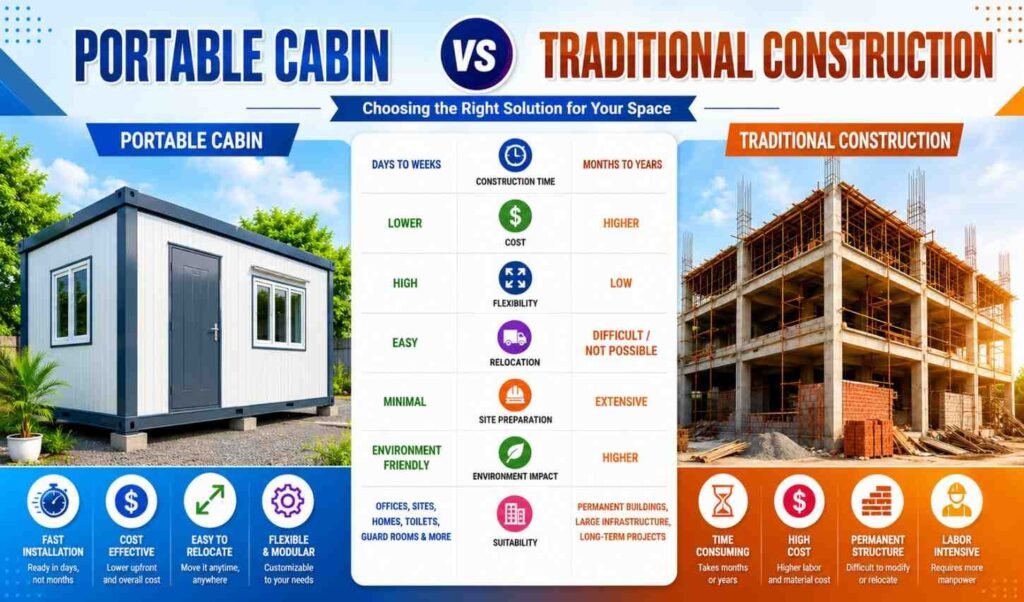
Choosing between a portable cabin and traditional construction is not a matter of preference but a strategic decision. This impacts the overall cost and time. Contractors and institutions must understand the difference between Portable cabins and traditional construction to fulfil their financial goals and operational needs.
Portable cabins are good and cost-efficient when you need fast deployment and flexibility. These prefabricated solutions are normally applicable for temporary offices and labour accommodations. The traditional construction method is used for permanent structures that require greater durability than portable cabins. Portable cabins are widely used in today’s fast-paced lifestyle. But for long-term infrastructure, traditional buildings are preferred.
Portable cabin vs traditional construction: Which is the better choice?
Here we discuss the key difference between portable cabin vs traditional construction in terms of 2 angles: cost and time. By considering facts like initial investment, approval process, and long-term value in constructing a building, this blog gives you an idea of how to choose between them.
Portable cabins are much cheaper than traditional construction. Also, they can be assembled within a few weeks. At the same time, traditional buildings need months or years to finish. For fast deployment needs in sites in India, portable cabins provide a clear advantage. But, as a permanent structure or long-life asset, traditional construction is the winner.
What is a portable cabin?
Portable cabins are prefabricated modular units and are made with lightweight interiors. Portable cabins are considered when you want the building to be transported and assembled quickly.
What is traditional construction?
Traditional construction involves permanent structures following conventional civil engineering practices. It uses on-site masonry and brickwork. The key comparison in portable cabin vs traditional construction revolves around cost, durability, time, and flexibility. Here we are comparing only the time and cost.
Comparison between cost (portable cabin vs traditional construction)
In terms of direct construction cost
- Portable cabins are typically 70% cheaper than traditional structures.
- The cost per square meter of portable cabins is less than that of traditional buildings. Because the materials are produced in bulk and foundations are minimal.
- The base prefabricated modular units are cheaper than constructing a traditional structure for a room or office.
- Traditional construction involves many processes like deep foundations, roofing, plastering, painting, etc. So, material and labour costs are high.
- For the same purpose, a traditional building can cost 3 times as much as a portable cabin.
In terms of Indirect and soft costs
- The assembly of portable cabins is fast, so supervision costs are much lower.
- Reduction in soft costs for portable cabins because there are no long-term site overheads.
- Traditional construction requires supervision and coordination costs. In addition, statutory approvals and detailed architectural design are needed.
- Indirect costs increase the total budget for constructing the traditional buildings.
Reliability or long-term value
- Portable cabins have a shorter lifespan, basically 10 to 20 years. They need proper maintenance. The resale value of these cabins is lower.
- The upfront cost of Traditional construction is higher. Nevertheless, it has a longer lifespan. Resale value is higher because it is a permanent asset.
- Traditional construction is best for homes, hospitals, and offices.
Comparison of time
Planning
- Portable cabins are suitable for temporary site use like temporary accommodations, offices, and storage, so architectural plans and approvals are not needed.
- These prefabricated structures design and customisation can be completed more easily than traditional structures.
- But traditional construction requires detailed design, such as architectural, soil investigation, and foundation design. They also need approvals from municipal and statutory authorities. This process alone can take months and depends upon the local regulations.
Duration of construction
- Portable units can be assembled quickly. If the units are small, 2 days are required to assemble. The occupancy can be done shortly after the assembly and utilities connection.
- In the case of traditional construction, small buildings like offices or residential buildings can be built within 6 to 12 months. But for larger buildings, it can take up to 3 years.
Flexibility
- Portable cabins can be modified or transported as the need changes. They are suitable for many purposes like labour accommodation, construction site offices, event spaces, etc. These cabins can be joined with more units if the project expands.
- But in traditional construction, changes require structural modifications and approvals. It requires a lot of time, cost, and effort for alteration. Flexibility is lower compared to portable cabins. Significant time and a huge amount are needed for that.
When to choose between a portable cabin and traditional construction
Portable cabin
- Opt for a portable cabin when the situation requires fast occupancy.
- When the structure is for temporary purposes like construction sites and mining camps.
- When your budget is tight, and you prefer a lower upfront cost.
- If you want to add or remove units as the project expands.
Traditional construction
- Choose traditional structures when your priority is a permanent asset.
- If the architectural quality and aesthetics are important, traditional construction is the right choice.
- If you want a permanent structure to use for years and want resale value.
- When you value durability and security, traditional construction will be a great choice.
Final comparison: Portable cabin vs Traditional construction
In the final comparison between the cost and time of portable cabins and traditional construction, both of them are good from their own perspectives. In terms of cost, portable cabins are way cheaper than traditional buildings. Initial investment for traditional structures is high. In terms of time, portable cabins need only days to weeks to be deployed. But traditional buildings need months and years.
Conclusion
To conclude, the choice between the portable cabin and traditional is dependent upon various factors such as the purpose and priorities of your project. Portable cabins are ideal for construction sites and temporary camps, while traditional structures are good for permanent and large commercial buildings.
If your need is temporary and time-sensitive, portable cabins are the perfect choice. But if the aim is to construct a permanent high-value asset and expect stability and resale value, traditional structures are a smarter choice.
FAQs
1.What is a portable cabin in simple terms?
Portable cabins are prefabricated units that can be transported and deployed quickly.
2.What is traditional construction?
Traditional construction uses various on-site methods to build permanent buildings.
3.In terms of cost, are portable cabins or traditional construction better?
Portable cabins are better as they are more cost-effective than traditional construction. Because upfront costs are higher for traditional construction.
4.What is the time duration to build a portable cabin compared to traditional structures?
Portable cabins can be set up within 2 days. For larger setups, it may take weeks. Traditional buildings take 12 months for smaller projects and years for larger projects.
5.How long can we use portable cabins?
The lifespan of a portable cabin is generally 10 to 20 years with proper maintenance.
Read More Blog:
Pre Engineered Building Manufacturers in Delhi NCR – Benefits, Features & Applications
Portable Office Cabin in Delhi NCR – Benefits, Uses & Complete Buying Guide 2026
Cement Panel Board Prefab Houses in Hyderabad: Cost, Benefits & Design Options