
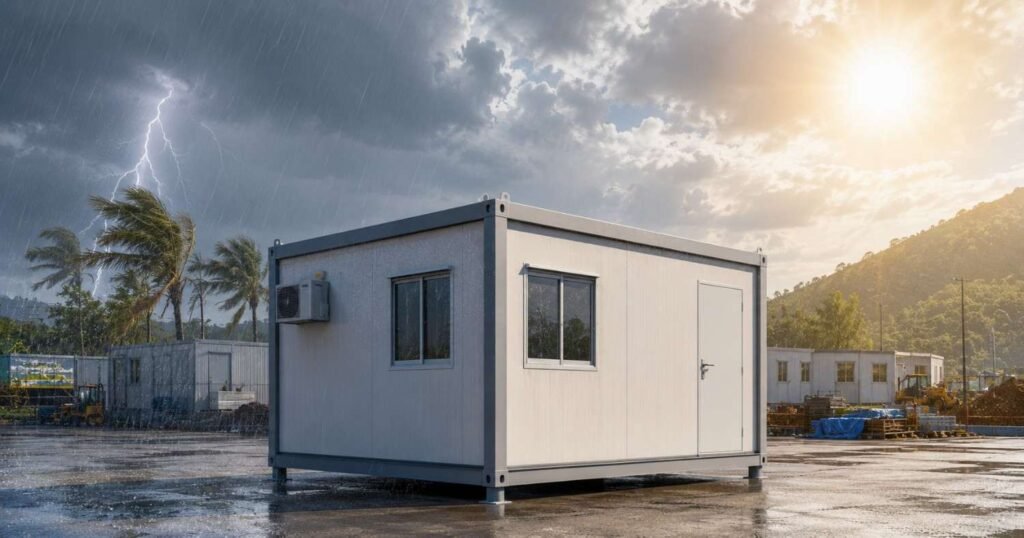
The weather conditions in India vary by region. This is actually a challenge for temporary and modular structures. Scorching summer is generally considered normal in Indian states like Rajasthan and Gujarat. In the case of Mumbai and Chennai, the coastal humidity is another kind of weather condition. So, while manufacturing portable cabins, they must be efficient and durable for the varying climatic conditions in India. They should provide safety and durability in such cases.
Weather-resistant portable cabins help in various ways in extremely challenging environments of India. Such portable cabins will have features like a strong structural frame, protective coatings, and insulated panels so that they can withstand exposure to diverse weather conditions. As India’s climatic conditions vary by state, there are regions that are strongly influenced by monsoon rains and humidity, and some other areas that are hot and dry, so portable cabins have to be built accordingly.
How Does a Portable Cabin Become Weather-Resistant?
A weather-resistant cabin is important for India as it has the ability to protect the occupants or users from demanding and extreme weather conditions like wind, dust, heat, rainfall, and humidity. A good cabin is capable of resisting water entry, regulating indoor temperatures, and creating comfort when exposed to extreme weather conditions.
The portable cabin becomes weather-resistant when it has :
- A robust steel framework.
- An insulated wall that controls heat transfer.
- A sealed roof that stops water accumulation.
- Corrosion-resistant materials that prevent moisture.
- Powerful anchoring systems.
- Good ventilation for controlling heat and condensation.
Weather-resistant cabins are the most suitable choice for various needs in construction sites, remote workplaces, and industrial facilities. They offer enclosed space without the time and expense of conventional structures.
Challenges of India’s Climatic Conditions
Selecting a portable cabin in regions in India must involve an assessment of the location and duration of use. For example, a cabin placed in the Western Ghats must be different from the one placed in a Himalayan valley.
Scorching Heat
Extreme summer heat is normal in many parts of India, like northern, western and central regions. The direct sunlight in such areas can increase the indoor temperature and make the occupants or users uncomfortable if the prefabricated cabins are poorly insulated. Intense heat due to direct sunlight also causes the cabin to expand and contract. This leads to cracks and leakage in the PEB structures. However, this problem can be resolved by insulated panels and UV- protected materials used in weather-resistant cabins.
Heavy Rainfall
In many parts of India, the southwest monsoon brings heavy rainfall. The rainfall is higher on the western coast and in the northeast. If rainwater enters the cabin, it can damage the electrical system and walls. Water accumulation around the foundation also causes issues like dampness and corrosion.
In high rainfall regions, it is recommended to make a portable cabin with features like extended roof edges, raised flooring, and rainwater drainage. Site preparation is also vital because even a waterproof cabin can be in vain if the prefab structure is installed on a waterlogged surface.
The Coastal Humidity
In coastal areas like Kerala, Mumbai and Goa, portable cabins are vulnerable to high humidity. Exposed electrical fixtures, hinges, and untreated mild steel components of portable cabins can lead to corrosion. In these situations, buyers must consider galvanised steel or anti-corrosion primer installations. Frequent checkups of the cabins are also recommended.
Strong Winds
The portable structures are vulnerable to seasonal storms and cyclonic weather conditions. The anchoring system and the condition of the installation site are important in such scenarios. The cabin must be secured with an anchor to a stable base. Fastening of roof sheets and wall panels is also important.
Cold and Snowfall
In cold regions like the Himalayas need different requirements apply. Freezing temperatures and snowfall in such areas can affect both the occupants and cabins. High-quality thermal insulation and sealed openings are needed to support snow loads. Other requirements are insulated flooring and heating systems.
Features of the Weather-Resistant Portable Cabins
Insulated Panels
Insulated panels are the main feature of a weather-resistant portable cabin. Panel systems like PUF and EPS help to minimise heat transfer between the interior and exterior space of the cabin. The insulation makes interior space cooler in hot regions and reduces the loss of indoor heat in cold regions. The required panel type can vary depending on the location and required indoor temperature.
Corrosion-Resistant Steel
The portable cabin’s structural support is the steel frame. Galvanisation and anti-rust primers act as protective measures to slow down corrosion caused by humidity and salt exposure. From the main frame to roof supports and other exposed metal parts, this corrosion protection protects the whole cabin.
Waterproof Roofing
The waterproof roofing protects the cabin from water accumulation in the sealing of the cabin. Durable roofing sheets and waterproof membranes are needed for weather-resistant portable cabins. For draining the water quickly, a sloping roof is needed. Other protective methods for draining water are installing gutters and downpipes.
Thermal insulation
Thermal insulation is unavoidable for the comfort of the occupants, and it also helps to reduce energy consumption. This insulation is installed around the walls and roofs continuously. Gaps around wiring points and windows can reduce the effect of thermal insulation; sealing of these regions must be careful.
Industries that benefit from weather-resistant portable cabins
Weather-resistant portable cabins are good for industries that need transportable and ready-to-deploy structures.
- On construction sites, these portable cabins can be used as labour accommodation and site offices.
- In mining areas, the cabins are useful for staff shelters and first aid units.
- The cabins are good for maintenance and operations cabins in solar parks and wind farms.
- In defence, these are suitable for field support facilities and storage rooms.
Other useful areas are event sites, disaster relief operation sites and educational institutions.
Why Choose Perfect Cabin?
Perfect Cabin helps you provide the right portable cabins in demanding conditions. Perfect Cabin is perfect for projects requiring portable structures. They offer you long-lasting comfort and safety. The applications of portable cabins are in construction and mining sites, defence, and renewable energy.
Perfect Cabin is a reliable supplier of good cabins with proper roofing systems, flooring, anchoring, and electrical safety. Customisation services are also provided according to the demanding conditions. With features like insulated panels, thermal protection, an water proof roofing, portable cabins are one of the best cabin providers all over India.
FAQs
1.Are portable cabins best at withstanding extreme heat?
Yes ,The insulated panels in portable cabins are best for scorching heat.
2.Can portable cabins withstand heavy rainfall?
With proper manufacturing and installation, yes.
3.In coastal areas, which portable cabin material is best?
Corrosion-resistant materials are best for coastal locations like Kerala and Goa.
4.Will the portable cabin stay strong in strong winds and cyclones?
It depends on the anchoring system and structural design.
5.Is regular maintenance required for the portable cabins?
Yes, regular maintenance supports the cabin’s life. Proper inspection is needed for demanding conditions.